The UAE Won Its Quota Fight: It Stopped Mattering
The UAE spent years arguing its OPEC quota sat below what it could actually produce. In 2026 it left the cartel to prove it. By June, the argument was largely settled: output hit 4.1 million barrels a day, an all-time high and within 100,000 barrels of the UAE’s assessed capacity ceiling (IEA, 10 July 2026; EIA, 23 June 2026).
The quota was never the real constraint
Brent crude crossed $100 a barrel on 23 July, up more than 30% in a month, after Houthi attacks on two Saudi tankers (CNBC, 23 July 2026). The UAE’s exit made the point moot: the binding constraint on Gulf oil supply is the Strait of Hormuz, not what OPEC lets any one producer pump.
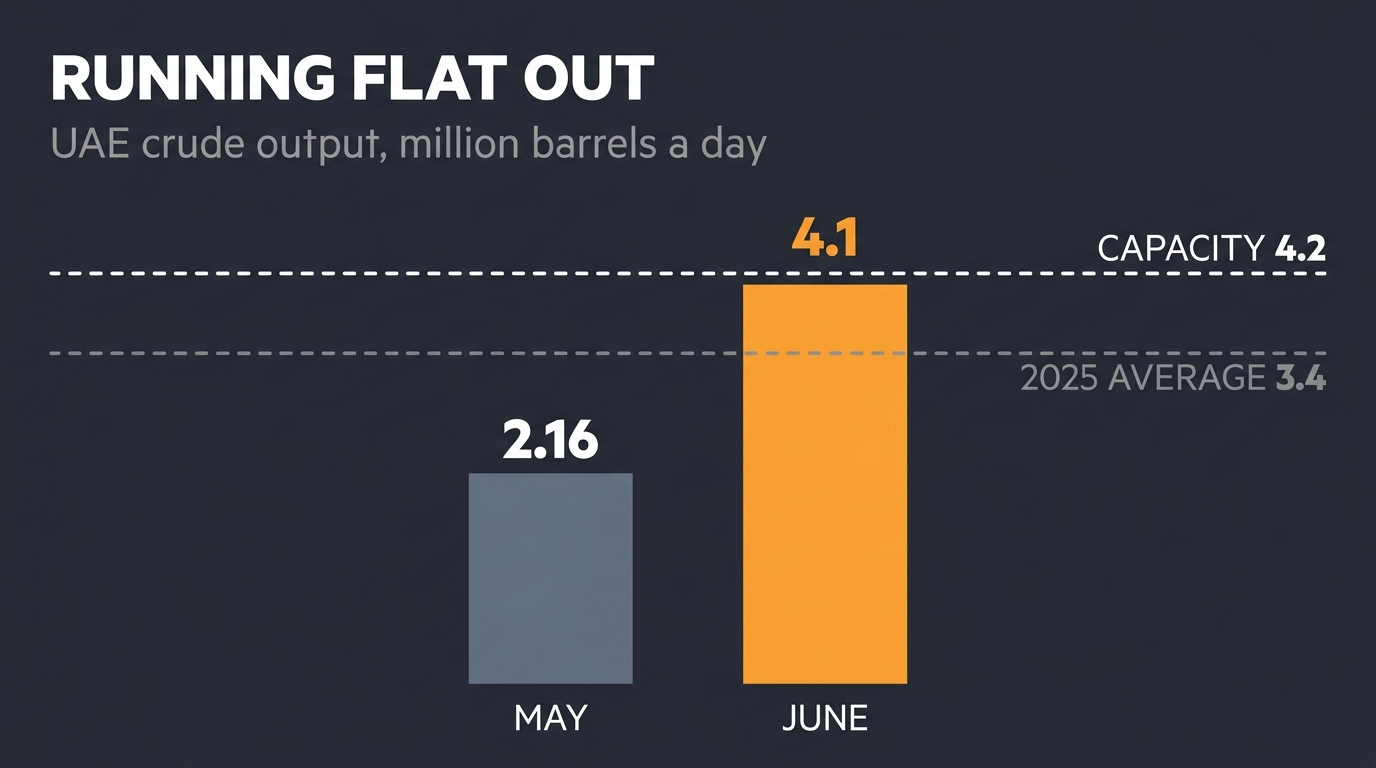
Most of June’s jump was recovery, not new supply. Saudi Arabia alone added 900,000 barrels a day that month.
What this doesn’t show: the “within 100,000 barrels” comparison rests on the EIA’s capacity estimate of 4.2 million barrels a day. ADNOC’s own target is closer to 5 million, and Al Jazeera has cited a current figure of 4.8 million. Against those figures, UAE output looks less like a ceiling and more like room still to grow.