Japan's Record Year of Buying Its Own Currency
Japan has spent 27.1 trillion yen defending the yen this year. The previous yen-buying record was 15.3 trillion, set in 2024. This year’s total is larger than the 2022 and 2024 campaigns put together.
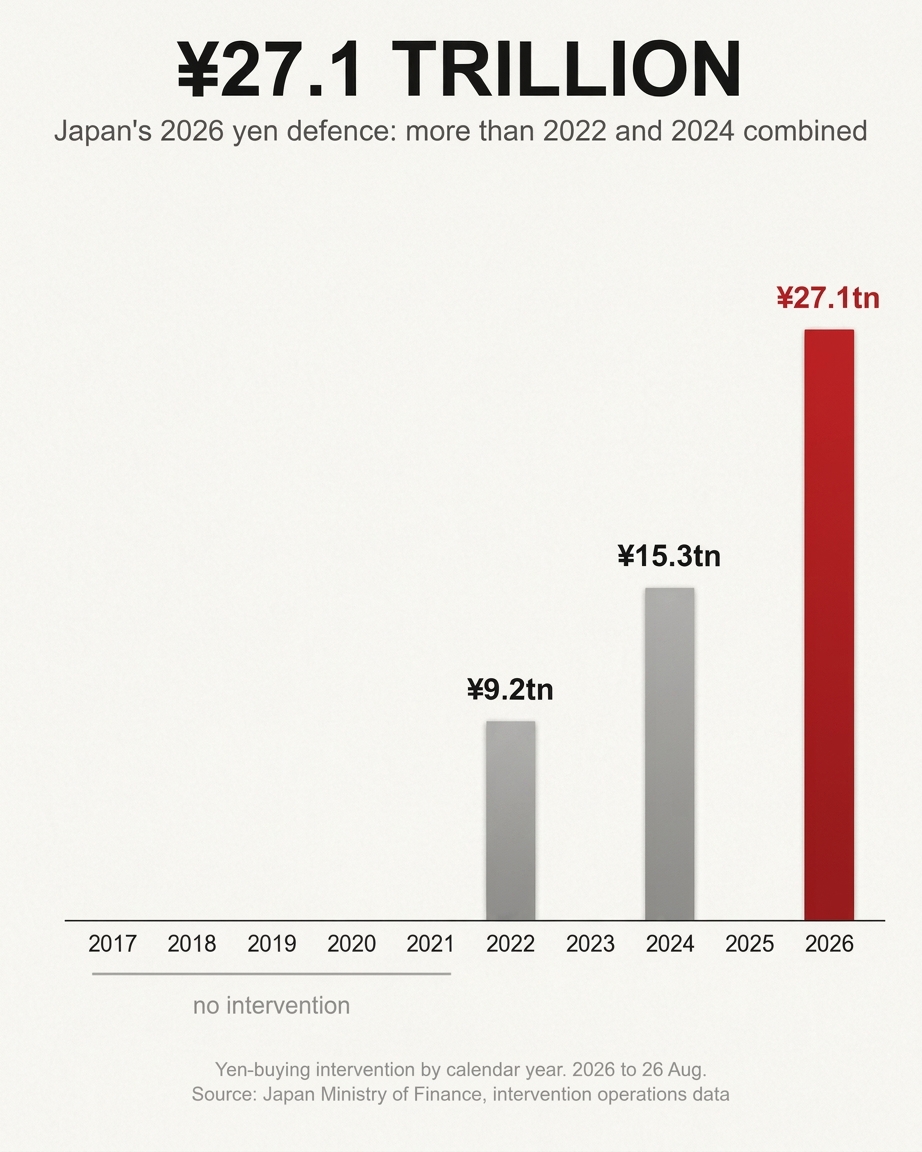
Three years out of ten
The Ministry of Finance publishes every operation it runs, back to 1991. Read by calendar year, the last decade is mostly blank: no intervention at all between 2017 and 2021, none in 2023, none in 2025. Japan acted in three years out of ten, and each episode was bigger than the last. 9.2 trillion yen in 2022, 15.3 trillion in 2024, 27.1 trillion so far in 2026, with four months still to run.
The most recent round is the heaviest. Between 30 July and 26 August the ministry spent 15.4 trillion yen, the largest stretch it has ever disclosed (Ministry of Finance, 28 August 2026). Foreign reserves fell 79.6 billion dollars in August, 6.18% in a single month, the steepest fall since the series began in 2000 (Ministry of Finance, 7 September 2026).
What it bought
The dollar peaked at 163.73 yen in late July, the yen’s weakest since December 1986. A joint US-Japan operation on 31 July, the first coordinated yen-buying since 1998, pushed it to 155.20 by 3 August. By 10 August it had slipped back to 159.31. Set 15.4 trillion yen against the 4.4 yen that actually held, and the defence cost roughly 3.5 trillion yen per yen. That ratio is mine, not the ministry’s: it publishes no cost-per-yen figure.
One honest limit: intervention exists to slow disorderly moves, not to set a level, and the slide did stop. But one-month implied volatility rose to around 10.5% from about 8%. The market got less calm, not more.