France Borrows More Expensively Than Greece
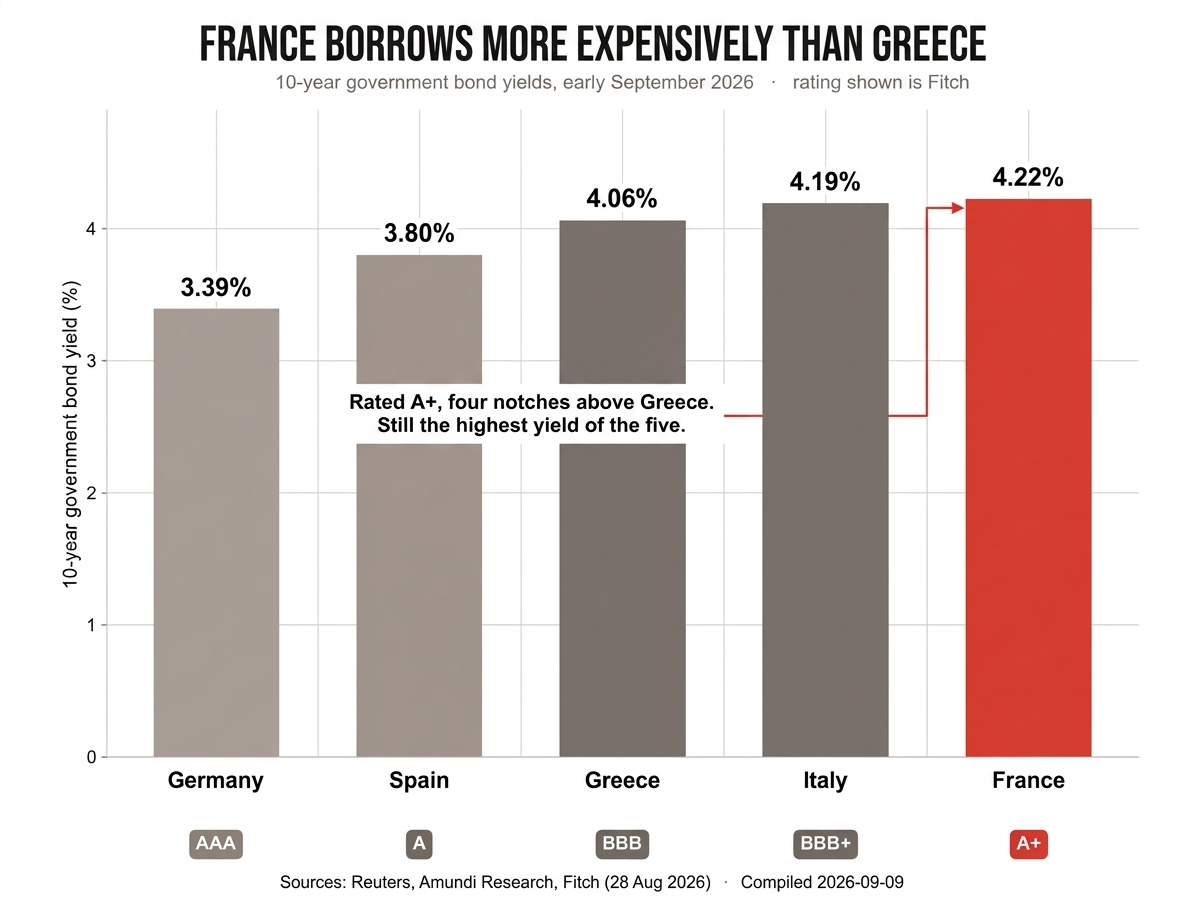
France now pays more to borrow for 10 years than Greece. On 3 September 2026 the French 10-year yield traded at 4.223%, against 4.057% for Greece (Reuters). The same day France sold new 10-year debt at auction at 4.23%, up from 3.90% in August and its highest auction rate since 2008.
The rating says the opposite
On the agencies’ scale, France sits well above the euro-area periphery. Fitch affirmed it at A+ with a stable outlook on 28 August 2026. Greece is rated BBB, four notches lower, and Moody’s only restored it to investment grade in March 2024. Italy, three notches below France at BBB+, was yielding about the same as France in early September and edged past it by the 8th. The countries the agencies rate below France are now, on the day, the cheaper borrowers.
Direction, not level
Debt levels do not explain the gap. Greek government debt was 143.5% of GDP in the first quarter of 2026, against 117.6% for France (Eurostat, 21 July 2026). What separates the two is the direction of travel. Greece has run primary surpluses since 2023 and cut its debt ratio by 9.4 percentage points in a year, the largest fall in the EU. France ran a 5.1% deficit in 2025, and Fitch projects its debt still climbing, to 122.7% of GDP by 2028.
The 2027 budget
The near-term pressure point is the 2027 budget. Prime Minister Sébastien Lecornu, who has no majority, must present it to the National Assembly on 30 September, with a deficit target that has drifted up to around 4.9% of GDP. The gap between French and German 10-year yields reached about 85 basis points in early September, up from roughly 55 at the start of the year (Amundi Research).
One honest limit: the lead over Greece is about 17 basis points and has reversed within a single trading day. Greece’s debt stock is still far larger. Investors are reacting to the direction of the deficit and the politics around it, not to today’s debt figures.