Spain's Resale Homes Are Outpacing Its New Ones
Resale homes in Spain rose 12.9% in the year to June 2026. New builds rose 7.4%. Both come from the same index, published by Spain’s National Statistics Institute (INE) on 7 September 2026: the 5.5-percentage-point gap runs the wrong way.
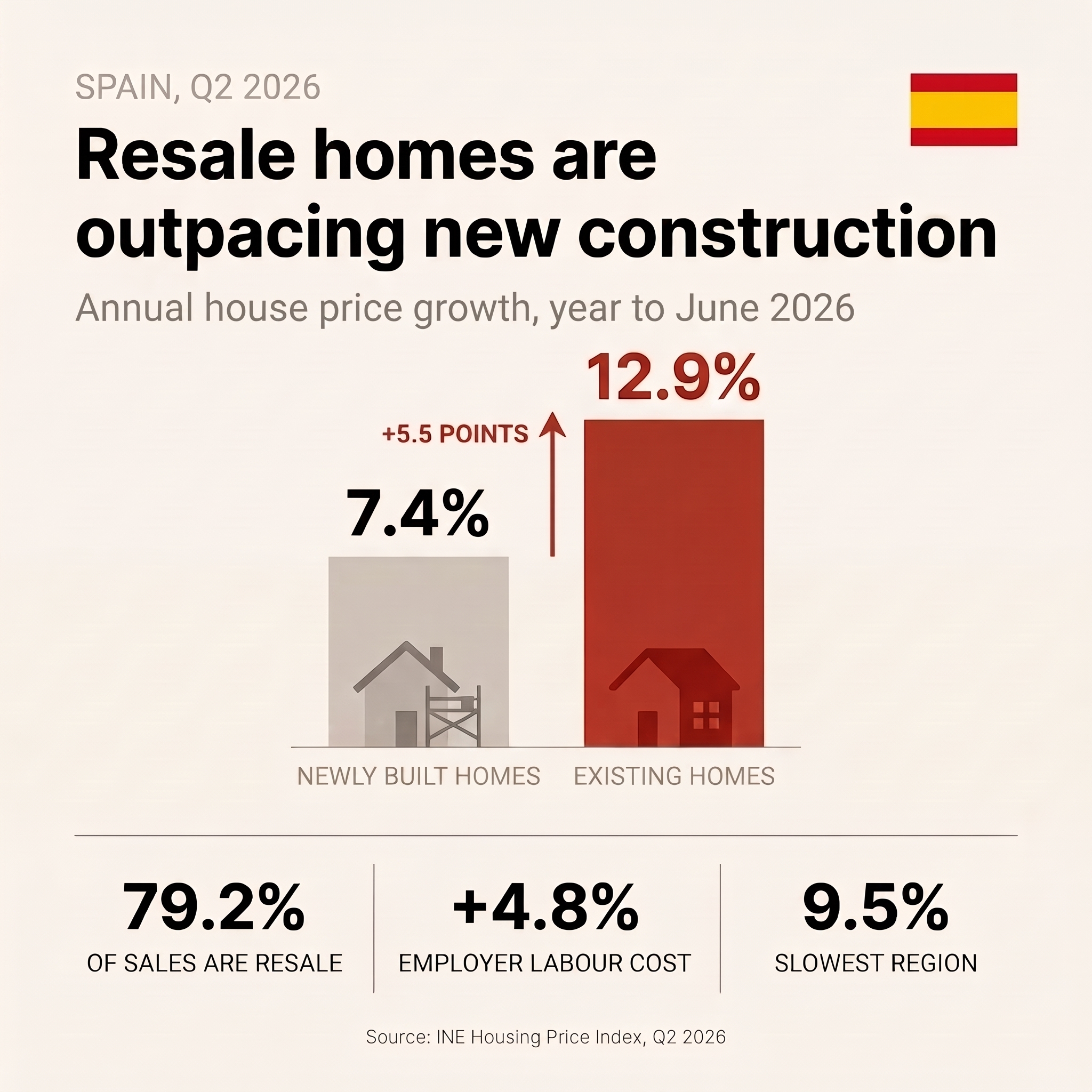
The inversion
New construction normally sets the pace. It costs more to build than to buy resale: land and labour price at today’s rates, so the new-build index usually leads. That held in Spain every quarter from late 2022 to late 2024. It has been inverted since mid-2025, and the two latest quarters pulled further apart: 4.4 points in Q1 2026, 5.5 in Q2. The path was not smooth. The gap had narrowed to 1.9 points in Q4 2025.
Q2 alone says the same: resale up 3.7%, new builds up 1.0%.
The shortage lands on the old stock
Supply is the mechanism, and it is not in the pipeline. Roughly 83,500 homes were completed in the year to September 2025, against 226,000 net new households formed that year (CaixaBank Research, 10 April 2026). Almost all buying happens in existing stock: 133,015 of the 167,934 homes sold in Q2 2026 were resale, 79.2% of transactions, per Spain’s Colegio de Registradores, the property registry (26 August 2026).
Pay is a long way behind
Employer labour costs rose 4.8% per hour worked in Q2 2026 (INE, 8 September 2026) against a house price index of 12.2%. That is two and a half times as fast, though illustrative rather than an affordability ratio: one is an asset price, the other an employer input cost. The slowest region, Navarra, still posted 9.5%.
One honest limit: the IPV is a transaction-price index built from notarial deeds, so the mix of homes sold shifts every quarter. Foreign buyers took 16% of Q2 2026 purchases, and if that money concentrates in coastal markets the index climbs even where individual home prices stay flat.