Luxembourg's Missing Pensioners
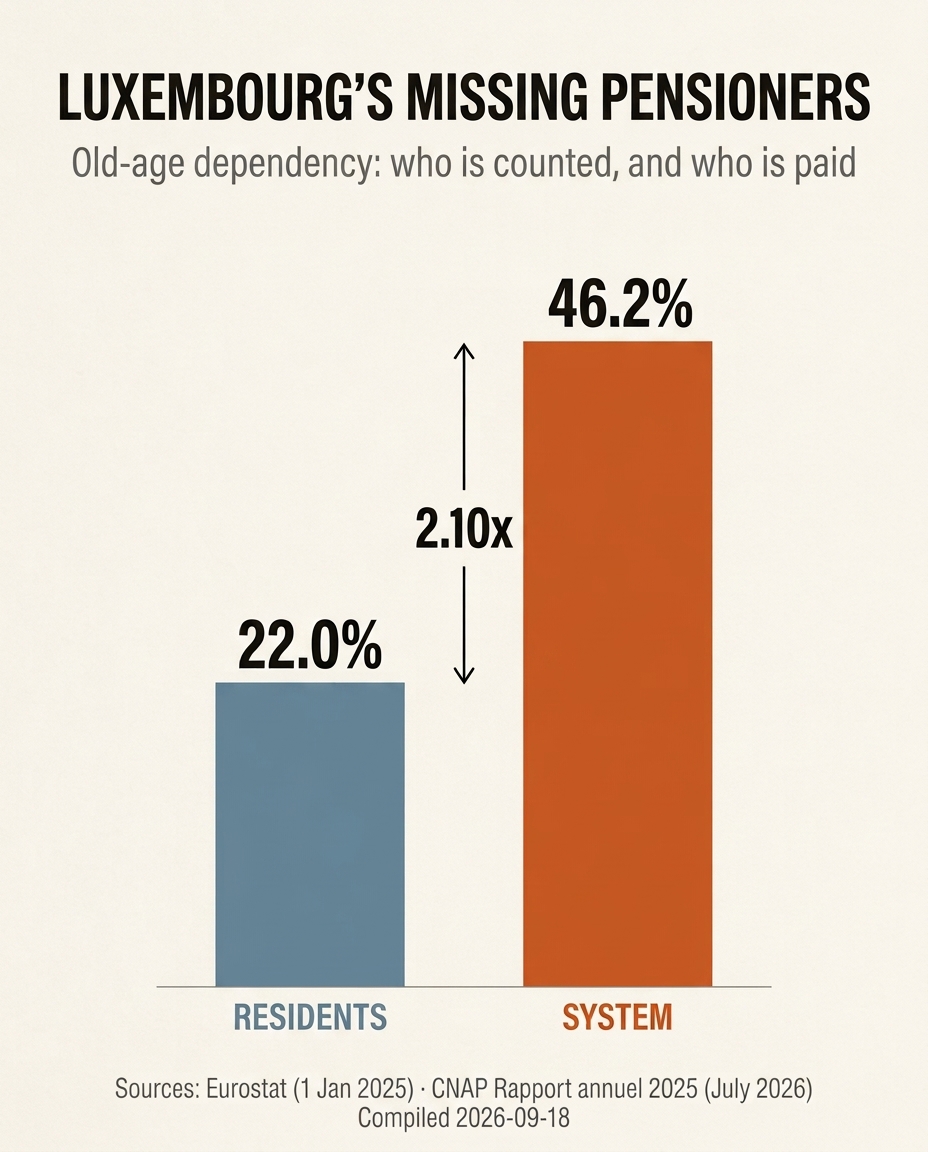
Luxembourg has the youngest population in the European Union: 15.2% aged 65 or over on 1 January 2025, against an EU average of 22.0%. Its old-age dependency ratio, residents aged 65 and over per 100 residents of working age, is also the EU’s lowest at 22.0%, well under the EU’s 34.5% (Eurostat, data extracted 2 February 2026). The two 22.0% figures are unrelated measures that happen to coincide.
The system counts differently
Beneficiaries per contributor, which the national pension fund (CNAP, the Caisse nationale d’assurance pension) calls the coefficient de charge, reached 46.2% in 2025, up from 42.4% in 2021 (CNAP annual report, July 2026). That is more than double the resident ratio, and it has risen in each of the last four years.
The two ratios answer different questions. The dependency ratio asks how many retirees live in Luxembourg for every working-age person who lives there. The pension system asks how many people draw a Luxembourg pension, wherever they live, against how many pay into it.
The cross-border model
Some 47% of Luxembourg’s roughly 494,000 salaried employees commute in from France, Germany and Belgium (STATEC, end-2025). They never enter the resident statistics, as workers or later as pensioners. The obligation to pay them stays on Luxembourg’s books regardless.
It shows in the payments. Luxembourg paid 125,687 pensions abroad in 2025 against 114,498 inside the country: 52% of the total, up from 39% in 2005.
What the accounts show
The pure pay-as-you-go premium, the contribution rate this year’s pensions would need from this year’s wages alone, hit 23.71% in 2025, up from 23.11% the year before, against a 24% rate. Parliament raised the rate to 25.5% from 1 January 2026.
Reserves stood at 32.05 billion euros at the end of 2025, an all-time high. Measured against a year of benefits, though, they slipped to 4.24 times, down from 4.39 in 2024 and 5.16 in 2021. One point deserves care here: the scheme’s headline 2025 surplus of 1.38 billion euros is about 90% investment income, and its fall from 3.28 billion in 2024 mostly tracks the reserve fund’s return dropping from roughly 12% to 4.45%. That is a market outcome, not a demographic one. The demographic signal is the coefficient de charge and the pay-as-you-go premium, both of which rose.
What the projections add
The European Commission’s 2024 Ageing Report, published in April 2024 on 2022 data, puts Luxembourg’s pension spending at 17.5% of gross domestic product by 2070: the highest of any member state, ahead of Spain at 16.7% and Belgium at 16.2%, against an EU average of 11.8%. Those projections predate the 2026 contribution increase.
52% of pensions leave the country. Only 34.27% of the euros do: pensions paid abroad are smaller, and 61.7% of beneficiaries built mixed, multi-country careers. Nor is the export purely a commuter story. Around 78% of exported pensions go to the three neighbouring countries; the rest go mostly to former residents who worked in Luxembourg and then returned home.