Belgium Borrows the Most and Owes the Fourth-Most
Belgium’s 2025 deficit came in at 5.2% of GDP: the largest in the euro area. Greece ran a surplus of 1.7%.
The title changed hands. France held it in 2024 at 5.8%, with Belgium on 4.4% (Eurostat, 22 April 2026). Only Romania (7.9%) and Poland (7.3%) did worse across the EU. Neither uses the euro.
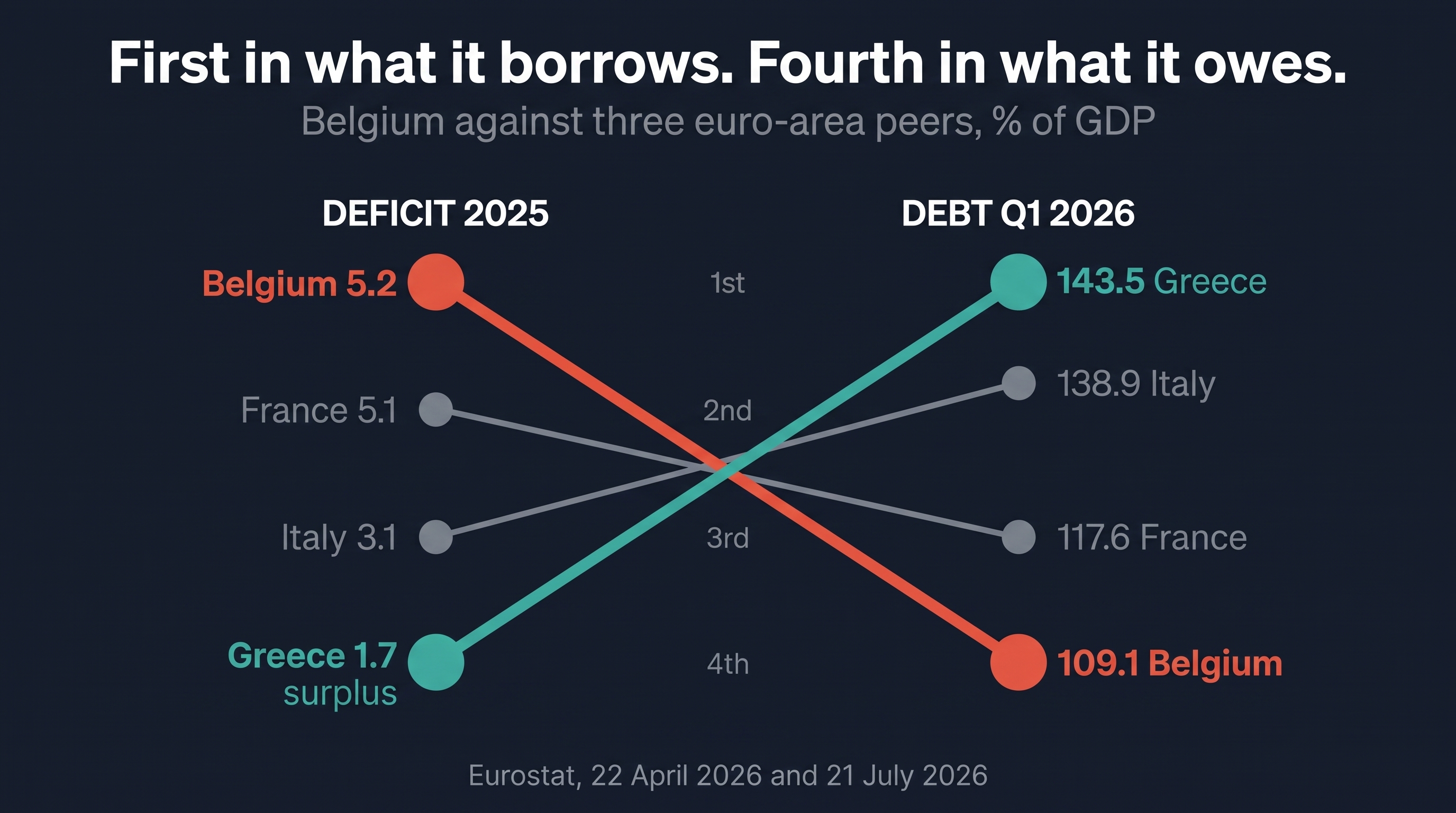
Debt tells a different story
Belgium stood at 109.1% of GDP at the end of the first quarter of 2026, fourth in the euro area (Eurostat, 21 July 2026). Greece carries 143.5%. Italy, 138.9%. France, 117.6%.
Belgium’s pile is mid-table. Its rate of addition is not. That distinction matters more than either number alone, because a stock reflects decisions already taken while a flow describes the ones being taken now.
What the forecasts show
The Monitoring Committee, the panel of senior officials that produces Belgium’s official budget projections, put the Entity I deficit, meaning the federal government plus social security, at 25.68 billion euros this year in its July 2026 report, rising to 38.3 billion by 2029 and 40.1 billion in 2030. The National Bank of Belgium’s June 2026 projection round has general government reaching 5.7% of GDP by 2028, with debt at 114.8%.
These perimeters do not match and should not be added together. The 5.2% and 5.7% cover general government. The euro figures cover Entity I only.
The ten billion
So the kern, the inner cabinet of the prime minister and his deputies, opened budget talks on 21 September, hunting 10 billion euros in annual savings by 2029. It has until 13 October to put the 2027 budget to parliament, the constitutional second-Tuesday deadline, and until 15 October to file the plan with the European Commission.
On the table: the top rate of VAT moving from 21% to 22%, higher health co-payments, and taxing non-profit organisations under the same rules as companies. Nothing is settled, and the VAT rise is one of two options, the other being a unification of the 6% and 12% brackets at 9%. MR leader Georges-Louis Bouchez calls raising revenue through taxes the dumbest plan the government could pursue.
The agencies have already moved
Moody’s cut Belgium to A1 on 17 April 2026 and S&P to AA− a week later, both citing the deficit. Fitch had gone to A+ in June 2025. All three now sit on stable outlooks; DBRS holds AA with a negative outlook (24 July 2026).
Belgium leads France by a tenth of a percentage point. These are first-notification figures, and Eurostat revises them on 21 October. A September report from the Monitoring Committee is also due, and would supersede the projections above.