Portugal's House Prices Rose 16.5% as Its Sales Fell for a Third Quarter
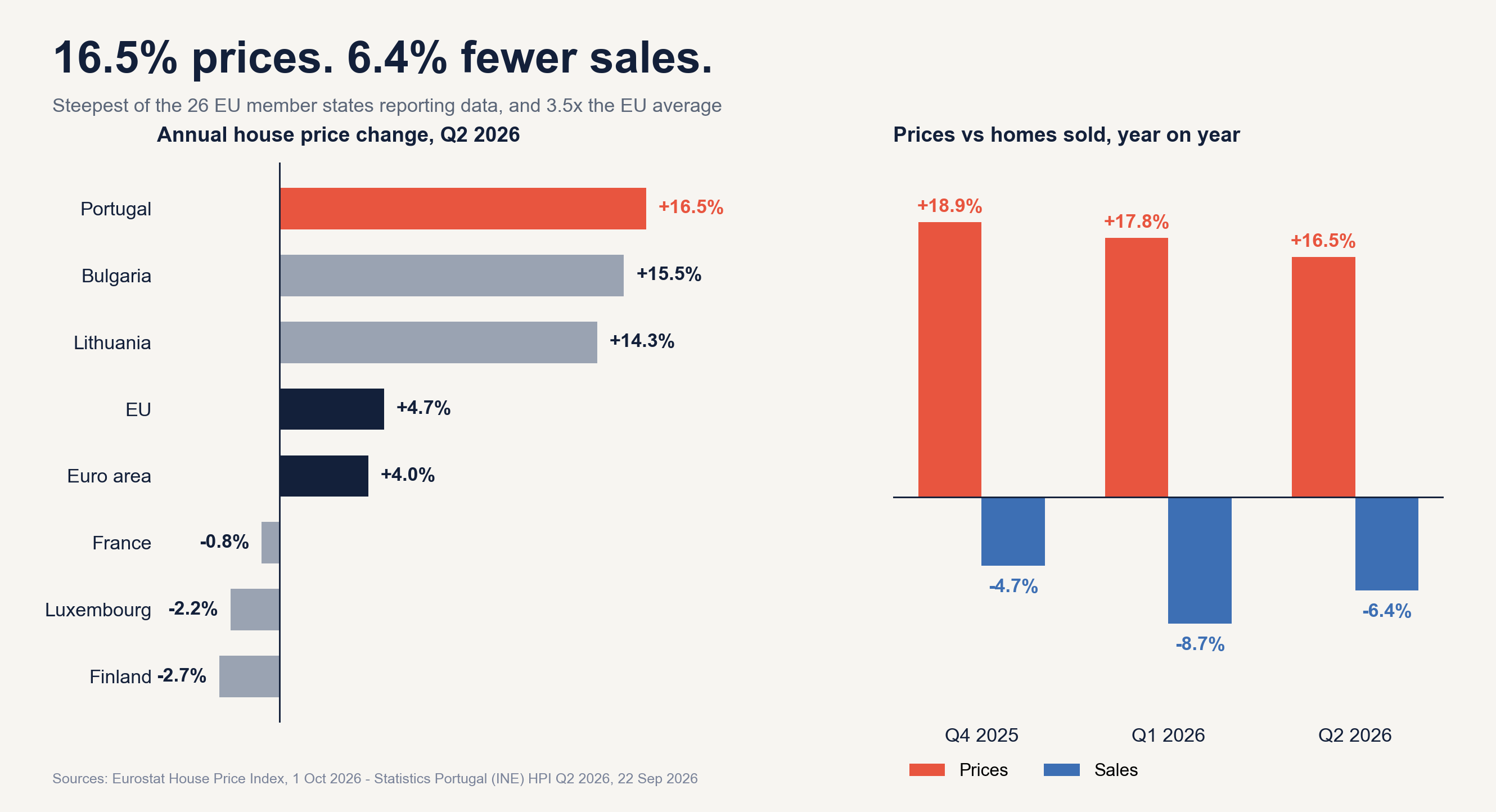
Portugal’s house prices rose 16.5% in the year to the second quarter of 2026: the steepest rise of any EU member state reporting data, and 3.5 times the EU aggregate of 4.7% (Eurostat, 1 October 2026). Over the same quarter, the number of homes sold fell 6.4%.
The field is more crowded than the multiple suggests
Bulgaria came second at 15.5%, Lithuania third at 14.3%. Prices fell in three countries, furthest in Finland at 2.7%, then Luxembourg at 2.2% and France at 0.8%. That puts 19.2 percentage points between the top and the bottom of the table. Greece reported no data, so Portugal leads the 26 member states that did.
The 4.7% aggregate flatters the gap. It is weighted, and Germany at 0.6% and France at minus 0.8% hold it down. Spain and Romania at 12.1%, Latvia at 11.4%, Croatia at 12.7% and Slovakia at 13.6%, alongside Lithuania and Bulgaria, were all in double digits. Portugal tops a crowded field rather than standing alone in one.
Prices up, sales down
Statistics Portugal counted 40,142 homes sold between April and June, down 6.4% from a year earlier (INE, 22 September 2026). That is the third consecutive annual fall: 4.7% in the fourth quarter of 2025, 8.7% in the first quarter of 2026, 6.4% now. Price growth across those same three quarters ran 18.9%, 17.8% and 16.5%.
Those sales were worth 10.7 billion euros, up 4.2% on 6.4% fewer homes. The average sale lands near 266,000 euros, roughly 11% above a year earlier: my arithmetic, not a published figure, and it sets an all-sectors value total against an all-sectors count. The money in the market grew. The market itself did not.
Who is left buying
Existing homes carried the index. They made up 80.5% of sales, 32,307 of them, and their prices rose 18.0% against 12.3% for new builds. Households bought 87.0% of the total, 34,935 homes, down 7.3% on the year.
Buyers with a tax residence outside Portugal took 1,890 homes, 4.7% of sales and down 10.3% from a year earlier, split almost evenly between the European Union at 946 and the rest of the world at 944. That category is narrower than the phrase “foreign buyers” suggests: it counts Portuguese emigrants and foreign-registered companies, and leaves out foreign nationals who live in Portugal and pay tax there.
Sales rose 6.4% between the first quarter and the second, and transaction value rose 7.8%, so the decline is a year-on-year comparison rather than a sequential one. The gap to the EU narrowed to 11.8 points from 12.7, and only because Portugal slowed: the EU rate came down too, from 5.1%. The index itself is hedonic, estimated from two adjacent quarters and controlling for the quality of what sold, so the 16.5% is not an artefact of which homes changed hands. The 11% average-sale figure is, and it probably runs opposite to the obvious guess, since new builds are the pricier segment and their share of units edged up.