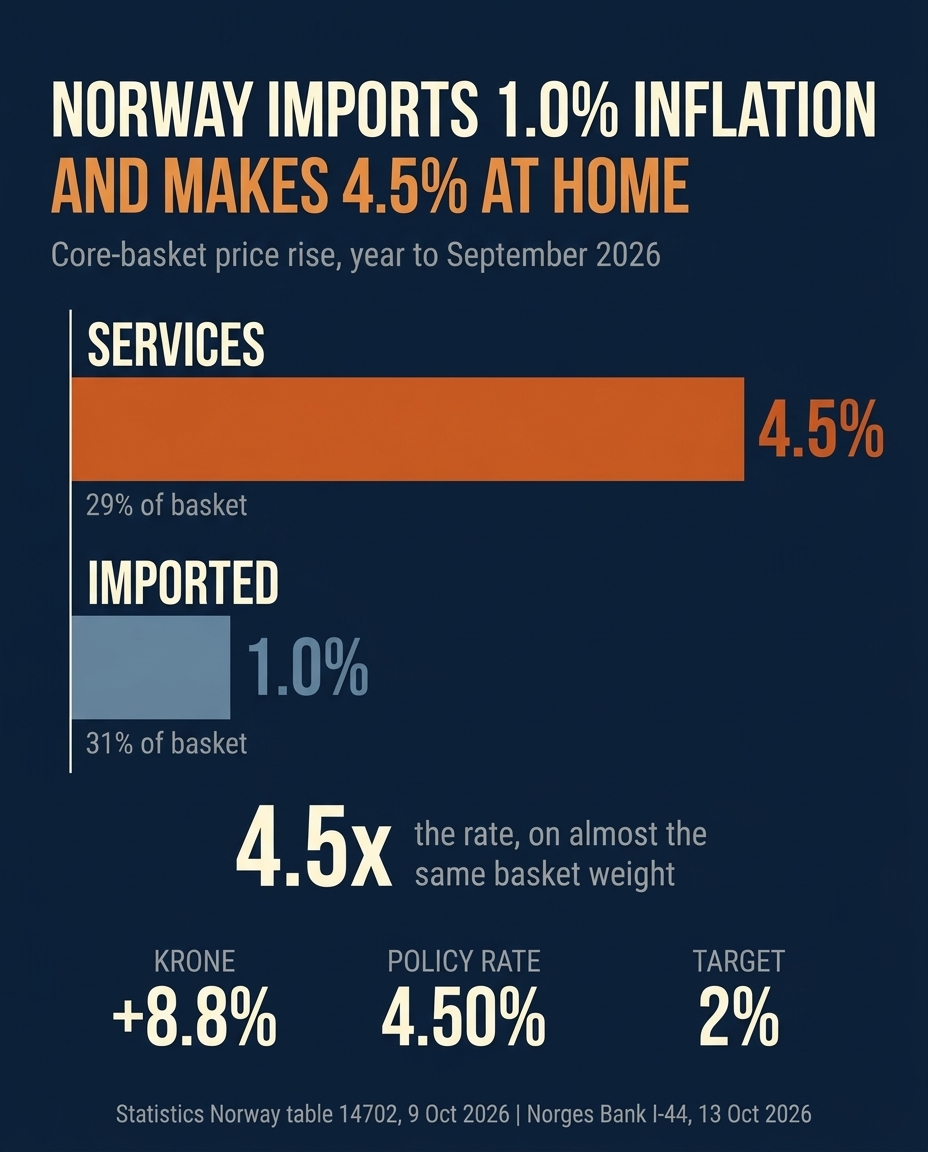
Norway Imports 1.0% Inflation and Makes 4.5% at Home
8.8%: how much more foreign currency a krone bought on 13 October 2026 than on 31 December 2025, measured against the basket of currencies Norway actually imports from (Norges Bank, import-weighted I-44 index).
The best-performing currency in the G10
Norway’s krone rose against all nine of its G10 peers between 31 December 2025 and 13 October 2026: 14.6% against the Swedish krona, 11.0% against the euro and against the Swiss franc, 9.9% against the Canadian dollar, 8.6% against the New Zealand dollar, 7.4% against sterling, 6.7% against the yen, 5.7% against the US dollar, and 1.2% against the Australian dollar (computed from Norges Bank daily rates).
Gaining against every peer makes it the year’s best performer. It does not make the krone strong in level terms. The I-44 fell from 119.86 to 110.15, and a falling index means a stronger krone, but 110.15 still sits in the weaker part of the range: the krone has been stronger than this in roughly four of every five months since 2000.
The central bank tightened anyway
Norges Bank raised its policy rate from 4.25% to 4.50% at its meeting on 23 September 2026, announced the following morning, and said it was prepared to raise further if the inflation outlook warranted it. Its own published rate path is flatter than that language: close to the current level for a period, then declining somewhat.
Core inflation came in at 3.0% in September and headline at 3.4%, against a target of annual inflation close to 2% over time (Statistics Norway, 9 October 2026).
Two near-equal slices, one inflating
Norway’s core measure, CPI-ATE, strips out energy prices and adjusts for tax changes. Imported consumer goods carry 309 of its 1,000 weight points. Services excluding rent carry 286, almost the same share of the basket.
The two are not behaving alike. Imported goods rose 1.0% in the year to September 2026. Services excluding rent rose 4.5%, the fastest since April 2025. The gap between them, 3.5 percentage points, is the widest in seventeen months.
Rent accounts for the other 293 points of the services block and rose 3.4%, which is why services as a whole ran 3.9% rather than 4.5%.
What the krone actually bought is unclear
The tidy version of this story says a strong currency crushed imported inflation and the central bank still had to tighten because services got away. The timing does not support the first half.
Imported-goods inflation climbed from 1.7% in January to 2.8% in May, through exactly the stretch where the krone’s year-on-year appreciation was steepest, then fell back as that appreciation eased. September’s 1.0% is close to the 1.1% recorded a year earlier, before the rally began, and sits inside the range the series occupied throughout 2025.
Governor Ida Wolden Bache framed it as an offset rather than a cure. Higher energy and commodity prices since June, she noted, “will result in higher costs for many domestic firms and higher prices for imported consumer goods”; on the other hand, the krone “will in isolation pull down inflation” (Norges Bank, 24 September 2026).
On that reading the appreciation has been holding the imported third of the basket flat against an upward push, rather than pulling it down. Either way it does not reach the domestic side, where the 2026 front-line wage frame settled at 4.4% in April on a price forecast of 3.2%, and where Norges Bank projects economy-wide wage growth of 4.5% this year.
One comparison worth not making: Norway’s 3.4% headline sits below the euro area’s 3.8% September flash estimate, but that is a national CPI against a harmonised index, and the euro-area figure is overwhelmingly energy, the component Norway’s core measure removes. Euro-area services ran 3.2% against Norway’s 3.9%, which is the like-for-like version and points the other way.