How Do You Value Bitcoin? Depends on What You Think It Is
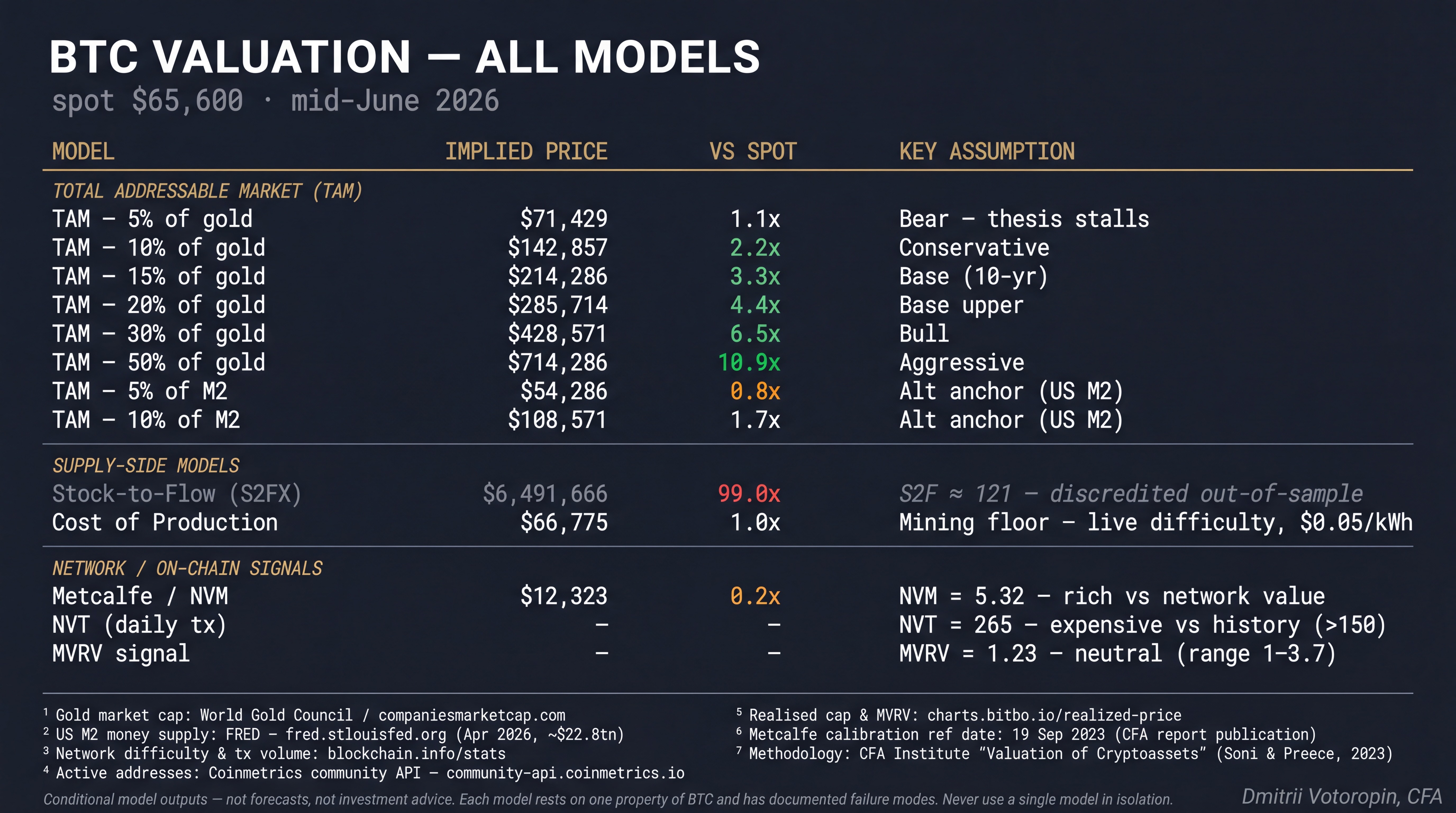
Valuing Bitcoin is harder than it looks, not because the math is complicated, but because there is no consensus on what Bitcoin fundamentally is. Is it digital gold? A monetary network? A commodity with a production cost? Each answer produces a different model, and each model produces a wildly different number. The table below collects all of them in one place.
Three families of models
The models fall into three groups. Total Addressable Market (TAM) models ask: if Bitcoin captures some share of gold or broad money, what should one coin be worth? Supply-side models look at scarcity (Stock-to-Flow) and mining economics (Cost of Production). Network and on-chain signals treat Bitcoin as a usage-driven asset, similar to how you’d value a payment network.
What they show right now
At $65,600, Bitcoin is already pricing in roughly 4.6% of the global gold market. The mining cost floor sits at $66,775, which means spot is essentially at the level where marginal miners break even. That is a historically meaningful point.
On the other hand, on-chain signals are less flattering. The Metcalfe model puts fair value at $12,323 with an NVM ratio of 5.3, and the NVT ratio at 265 is in expensive territory by historical standards. MVRV at 1.23 is neutral: holders are on average 23% in profit, well below the distribution zone that has historically preceded major drawdowns.
The range is the answer
The spread from $12,323 to $714,000+ is not a bug — it is the honest answer. Every model captures one property of Bitcoin and ignores the rest. Stock-to-Flow focuses on supply scarcity and misses demand entirely — it is flagged as discredited in the table because it failed badly out-of-sample after 2021. Metcalfe focuses on user counts but misses that many holders now sit in ETFs and never touch the chain. No single number is “the” fair value.
The useful output is the ensemble: where models agree, conviction is higher; where they diverge, uncertainty is real. Right now the cost-of-production floor and spot price are nearly identical, which sets a clear fundamental anchor on the downside. The upside range depends entirely on how far Bitcoin’s monetary thesis advances, and that is a question about adoption, not arithmetic.
All outputs are conditional model results. Not forecasts, not investment advice.